
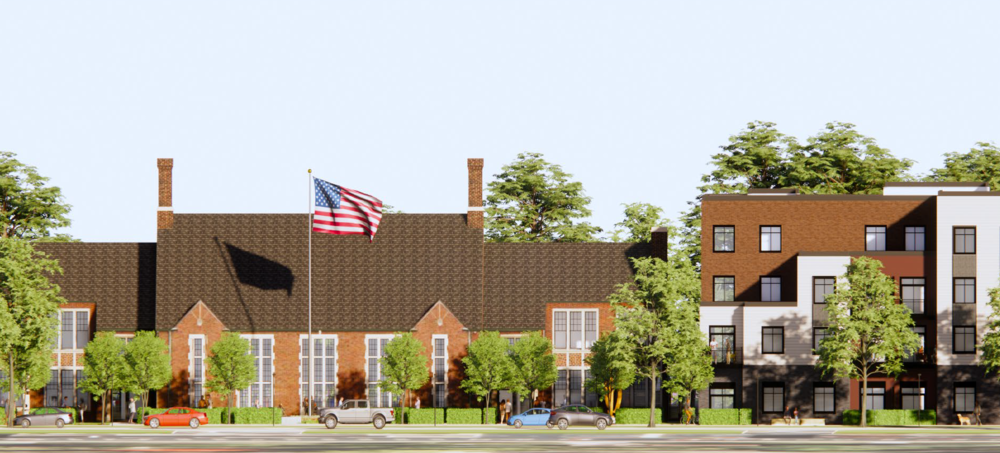
The City of Lathrup Village continues to review an update to its PILOT Ordinance in association with the redevelopment of the historic Annie Lathrup School at 27700 Southfield Road. The proposed project would preserve the original 1926 school building while transforming the property into a new residential development, bringing significant private investment to the Village Center and putting a currently unused property back into productive use.
The project has been under review by City boards and commissions since 2024. As part of the ongoing review, City Administration has examined questions about the proposed housing, the Payment in Lieu of Taxes (PILOT) agreement, potential impacts on City services, and the anticipated community benefits.
What Is Being Proposed?
The proposed redevelopment would retain and rehabilitate the original historic school building while removing additions constructed in the 1950s. Two new four-story apartment wings would be constructed and connected to the historic building through glass connectors.
The development would include 145 apartments, 83 one-bedroom units and 62 two-bedroom units. The original school building would be repurposed for tenant amenities, including recreation areas, meeting and learning rooms, co-working space, and event space. Plans also envision restoring the historic gymnasium as a clubhouse. Parking would be located behind the building (not within Annie Lathrup Park), with no vehicle access directly onto Southfield Road.
Surnow Company, the private developer, currently estimates total project costs at approximately $43 million. The project has received design approval from the Historic District Commission and site plan approval from the Planning Commission. City Council has also approved an encroachment license allowing 18 parking spaces within the public street right-of-way.
The intent of the redevelopment would combine the historic character of the original school with new residential construction, helping reinvest in an existing property rather than leaving the building vacant.
Why Workforce Housing?
The proposed development is being pursued as workforce housing through a program administered by the Michigan State Housing Development Authority (MSHDA). Workforce housing is intended to provide rental opportunities for households in a stable financial position whose incomes may make it difficult to find housing that fits their budgets in the communities where they work and live.
The developer's market analysis identified a limited supply of available multifamily housing in the project's primary market area (within 5 miles of Lathrup Village). The analysis reported a vacancy rate of approximately 3% among 4,426 multifamily units, based on research conducted in 2024. A vacancy rate below 5% is commonly used in the analysis to indicate a constrained rental market. The analysis noted that only one multifamily project in the identified market area had opened since 2017, before the proposed development.
The development is intended to offer housing options for a range of households, including working professionals and essential workers such as teachers, nurses, police officers, and other employees. Depending on household income and size, some retirees and students may also qualify.
How Are Income Limits Determined?
Eligibility is based on Area Median Income (AMI), a measure established by the U.S. Department of Housing and Urban Development (HUD). The applicable income limits vary by household size and are updated annually.
The current plan includes:
29 apartments at 50% AMI, intended for households with lower incomes.
116 apartments at 120% AMI, intended for households earning up to the applicable program limit.
These restrictions do not mean every apartment is available to every household. Prospective tenants must meet the income requirements and other eligibility rules applicable to their unit.
The developer's illustrations show proposed rents of approximately $1,098 per month for the 29 apartments restricted at 50% AMI, $1,800 for a one-bedroom apartment, and $2,200 for a two-bedroom apartment. These are projected figures presented by the developer, and actual rents will be subject to the applicable program requirements and final project terms.
The development is not a low-income Section 8 housing project, and the applicable City PILOT ordinance and MSHDA financing agreement do not allow the property to be converted to Section 8 housing.
Understanding the PILOT Agreement
A Payment in Lieu of Taxes, or PILOT, establishes a special tax arrangement for a qualifying development in place of standard property taxation. For this project, the PILOT would allow the development to make payments calculated under the applicable workforce housing program.
Why is this arrangement necessary? Based upon the developer's financial presentation, the project would not meet its financing requirements without the PILOT. The developer's projections show that, without the arrangement, the project would experience negative cash flow during its first several years and would not meet the lender's required debt-service coverage ratio until approximately Year 15. With the PILOT, the projections show the project meeting that financing requirement in its first year.
These figures are based on the developer's financial assumptions and are intended to demonstrate why the PILOT is important to securing project financing. Surnow Company has indicated that without the agreement, the project would not be financially feasible and redevelopment would be unlikely to proceed.
The proposed PILOT term is 40 years. City Council is reviewing amendments to the City's governing ordinance to align it with the PILOT terms previously approved through a Council resolution and the requirements identified by MSHDA.
What Would the City Receive?
The proposed Payment in Lieu of Taxes (PILOT) agreement would provide revenue to the City of Lathrup Village, the Lathrup Village Downtown Development Authority (LVDDA), and other eligible taxing authorities.
Projected PILOT Revenue Over 40 Years
Based on an assumed average monthly rent of $1,900 per apartment, with annual rent increases of 3%, total PILOT payments are projected to reach approximately $10.4 million over 40 years.
The estimated distribution is as follows:
Taxing Authority | Projected 40-Year Revenue |
|---|---|
Other eligible taxing authorities | $5.2 million |
LVDDA | $2.6 million |
City of Lathrup Village | $2.6 million |
Total PILOT payments | $10.4 million |
Under this arrangement, the LVDDA and the City would each receive an estimated $2.6 million over the 40-year term, based on the approved PILOT revenue-sharing agreement. These figures are projections based on current assumptions and remain subject to the final agreement terms and applicable distribution requirements.
For comparison, the property currently generates approximately $23,000 in annual property taxes. The LVDDA receives roughly $11,500 of that amount, while the City receives no direct revenue. The proposed PILOT would establish a new revenue stream associated with the redevelopment.
The proposed PILOT resolutions also include a minimum annual payment of $120,000, providing a baseline payment regardless of occupancy, subject to the final agreement terms.
Could the Development Increase Other City Revenues?
The development could also affect state revenue distributions by increasing the City's population. However, these potential increases are difficult to predict because state funding formulas consider several factors beyond population.
State Revenue Sharing: The City's projected Fiscal Year 2027 State Revenue Sharing is approximately $470,000. For comparison, Bloomfield Hills and Wolverine Lake, with populations of approximately 4,444 and 4,504, respectively, project approximately $448,000 and $467,000 in the same revenue category. These comparisons illustrate that population alone does not determine how much state revenue a community receives.
Act 51 Transportation Funding: Lathrup Village currently receives approximately $58,000 per month in Act 51 transportation funding. Bloomfield Hills receives approximately $66,000 per month, while Wolverine Lake receives approximately $52,000. Because Act 51 distributions also consider eligible street mileage, additional residents should not be assumed to generate a proportional increase in transportation funding.
Neither State Revenue Sharing nor Act 51 funding can be reliably forecast over 40 years. Future distributions will depend on statutory formulas, legislative decisions, population, taxable value, eligible road mileage, and other applicable factors.
These potential revenue effects are therefore not treated as guaranteed financial benefits of the development.
Will the Development Affect City Services and Infrastructure?
The City recognizes that adding 145 apartments would introduce additional residents and could increase demand for police, fire protection, roads, utilities, administration, and other municipal services.
City staff and engineering consultants have reviewed the potential impacts on water service, stormwater management, sanitary sewer capacity, roads, and municipal operations. Based on the current engineering review, existing water and sewer systems are expected to accommodate the development, subject to final building design, fire-protection requirements, and applicable approvals. The site plan also includes on-site stormwater detention to help manage runoff.
Municipal Staffing and Operating Costs
Based on the City's current budget and staffing structure, the Administration does not anticipate that the development would create an undue financial burden or require additional staff as a direct result of the project.
The Police Department currently has one vacant full-time patrol officer position resulting from budget reductions. The City would seek to refill that position if funding becomes available, regardless of whether the proposed development proceeds.
The development is also not expected to create new public spaces requiring City maintenance or necessitate the establishment of new City programs.
Actual service costs will depend on future conditions, including how residents use municipal services, changes in operating expenses, and the City's future service priorities. These factors will continue to be evaluated through the annual budget process.
Water and Sewer Revenue
The property would be subject to the City's approved water and sewer rate structure. Based on current rates and estimated consumption, the City projects that the development could generate more than $50,000 annually in water and sewer revenue, depending on final meter sizes, meter counts, and actual usage.
This revenue would help offset additional costs assessed to the City by the South Oakland County Water Authority (SOCWA) and the Evergreen-Farmington Sewage Disposal System (EFSD), while contributing toward future utility system expenses and capital improvements.
The estimated utility revenue is separate from PILOT payments and would be collected through the City's standard utility billing process.
How Is the City Evaluating the Long-Term Financial Impact?
A 40-year financial forecast involves considerable uncertainty. Inflation, changes in revenue, infrastructure needs, service demand, and future policy decisions can all affect the City's financial position.
To evaluate the potential impact of the proposed development, the Administration has considered the City's broader financial outlook, including projected revenue growth, operating expenditures, recurring equipment replacement, facility maintenance, and future capital needs.
Financial Modeling Assumptions
For preliminary modeling purposes, the City's projections assume:
Approximately 3% annual taxable value growth.
Appropriate adjustments to municipal fees over time.
Approximately 3% annual expenditure growth.
Continuation of current municipal service levels.
The projections incorporate known recurring expenses, such as police vehicle replacement, Department of Public Works equipment, and municipal facility maintenance. Estimating future service delivery costs is more difficult because those costs depend on how demand, operating conditions, and policy decisions change over time.
Under these assumptions, the City's analysis does not currently indicate a negative financial impact in any municipal service area attributable to the development.
Importantly, this analysis evaluates the City's overall financial position rather than attempting to assign every municipal expense directly to the development's future residents. The objective is to assess whether anticipated revenue growth and other available resources are likely to keep pace with broader operating and capital costs.
What Do the Long-Term Projections Show?
Based on the current model, which assumes continuation of existing service levels:
Without PILOT payments: The City could increase its fund balance by approximately $140,000 per year by Year 40.
With projected PILOT payments: The potential increase in fund balance could approach $250,000 per year by Year 40.
These figures represent the projected annual financial position at the end of the modeling period. They are not cumulative increases in fund balance over the entire 40 years.
The projections suggest that, under the assumptions used, the City's overall financial position could remain positive while accommodating the development.
However, the results are estimates, not guarantees. Actual outcomes will depend on future economic conditions, inflation, service demands, revenue distributions, and the budgetary priorities and spending decisions of successive City Councils.
What Does This Mean for the City's Long-Term Financial Position?
Based on the assumptions and projections currently available, the Administration does not anticipate that the proposed Surnow development would create an undue financial burden on Lathrup Village.
The projected PILOT payments, anticipated utility revenue, and existing municipal staffing and service structure indicate that the development could be accommodated within the City's long-term financial planning framework.
The financial analysis also recognizes that the City would continue to experience operating expenses and capital needs regardless of whether the development proceeds. Maintaining police vehicles, public works equipment, municipal facilities, roads, and utility infrastructure will remain ongoing responsibilities.
A 40-year PILOT agreement represents a significant long-term commitment, and future financial conditions cannot be fully predicted today. The projections should therefore be viewed as a planning tool for evaluating potential benefits and risks, rather than a guarantee of future financial performance.
Ongoing Financial Oversight
The City will continue to evaluate revenues, service demands, infrastructure conditions, and operating costs through its annual budget and Capital Improvement Plan (CIP) processes.
These processes allow future City Councils to review actual financial performance, adjust spending priorities, and respond to changing conditions as they arise.
The goal is to ensure that decisions regarding the Annie Lathrup School redevelopment are informed by the best available financial information while protecting the City's long-term fiscal stability and ability to provide services to residents.
Parking, Traffic, and Construction
The approved site plan includes on-site parking, along with 18 spaces authorized through the City's encroachment license. The developer may also pursue shared parking agreements with nearby commercial properties if additional parking is needed.
To help limit cut-through traffic on nearby residential streets, vehicles exiting the property on the north side will be required to follow posted “No Right Turn” signage. Violations would be subject to enforcement by the Lathrup Village Police Department.
Any planned traffic disruptions along Southfield Road during construction will be subject to applicable permitting and approval requirements from the Road Commission for Oakland County.
Construction remains contingent on the developer securing project financing and completing the necessary building plans and approvals. If financing closes in December 2026, the developer anticipates construction will take approximately 18 to 24 months.
Community Benefits
Beyond the redevelopment of a historic property, the approved site plan includes improvements to the City's adjacent dog park and repaving of a nearby walking path within Annie Lathrup Park.
The project also represents a substantial private investment in the Village Center. Research conducted by the Michigan Economic Development Corporation has identified potential positive effects of redevelopment on surrounding neighborhoods and commercial corridors, including increased occupancy and nearby property values. The research cited in the City's review examined projects in six Michigan cities between 2008 and 2019.
These findings suggest possible benefits for the surrounding area, although they do not guarantee that property values near Annie Lathrup School will increase by a particular amount.
The project could also support the City's broader goal of diversifying its housing stock and creating more options for people who want to live in Lathrup Village at different stages of life. The developer identified potential residents ranging from essential workers and young professionals to seniors seeking alternatives to homeownership.
Access to amenities within the development will be determined by the developer, and any future opportunities for additional community benefits may be considered as the project progresses.
Staying Informed
The City has had nearly 30 meetings associated with the project & PILOT over the past two years and recognizes the importance of evaluating the long-term financial, infrastructure, and community implications of this proposal. City Council continues to review the PILOT ordinance amendment and associated documentation, with the goal of understanding the terms and anticipated impacts before final decisions are made.
Residents can follow project discussions and review meeting agendas, minutes, and related materials through the City of Lathrup Village's website at www.lathrupvillage.org.
The City's goal is to make informed decisions that support responsible redevelopment, protect municipal resources, preserve the community's historic character, and advance the long-term interests of Lathrup Village.
Additional Information
Additional frequently asked questions (FAQs) can be found in the October 19 City Council Study Session packet.
The Surnow Company PILOT presentation slide deck can be found in the October 19 City Council Regular Meeting packet.